
Have you ever noticed your skin acting up during a hard week? A big deadline. A sleepless night. A difficult conversation. And then — a breakout. Redness. Dryness. Clearly, that is not a coincidence. In fact, your skin and your stress levels are deeply connected. Understanding that connection may, therefore, be the most important skincare step you take this year.
What Happens to Your Skin When You’re Stressed?
First, let’s look at what stress actually does inside your body. When you feel stressed, your body releases a hormone called cortisol. This is your body’s alarm signal. As a result, it prepares you to deal with danger. However, it also causes real problems for your skin.
Specifically, cortisol tells your sebaceous glands to produce more oil. More oil then clogs your pores. Consequently, clogged pores lead to breakouts. It is that direct.
But there is more. In addition, stress triggers inflammation throughout your body. This, in turn, makes your skin look red, puffy, and irritated. At the same time, stress weakens your skin barrier. That is the protective outer layer of your skin. As a result, your skin loses moisture faster. It also becomes more sensitive and much slower to heal.
So, in short, stress does not just cause one skin problem. Instead, it causes several at once.
Common Skin Problems Linked to Stress
Stress shows up on skin in different ways. However, some patterns appear again and again. Here are the most common ones.
Acne and Breakouts First and most commonly, cortisol increases oil production. That oil, in turn, feeds acne-causing bacteria. As a result, stress breakouts often appear on the jawline, chin, and cheeks. Moreover, they tend to last longer than regular pimples. That is because cortisol also slows down skin cell repair.
Dryness and Dehydration Similarly, a damaged skin barrier loses moisture very quickly. As a result, your skin starts to feel tight and flaky. It may also look dull. Interestingly, this can happen even if you use the same moisturizer every day.
Eczema and Rosacea Flare-Ups Furthermore, stress is a well-known trigger for both eczema and rosacea. The inflammation from cortisol makes these conditions harder to manage. Consequently, symptoms become more intense and more frequent during stressful periods.
Dull and Tired-Looking Skin In addition to all of the above, stress disrupts your sleep. Without good sleep, your skin simply cannot repair itself. As a consequence, dead cells build up. Collagen production also slows. As a result, your skin starts to look grey and tired.
Premature Aging Finally, long-term stress keeps cortisol elevated for months or years. Over time, this breaks down collagen and elastin. These are the proteins that keep skin firm. Therefore, fine lines appear faster. Ultimately, skin loses its bounce and glow.
The Mind-Skin Connection Is Real
For years, people treated skin and mental health as completely separate topics. However, that is no longer the case. Today, the field of psychodermatology studies exactly how emotions affect skin health.
According to Healthline, severe stress can weaken your skin’s outer layer. As a result, your skin becomes more vulnerable to infection. It also heals much more slowly. These are measurable, biological changes — not imagination.
In addition, there is a frustrating cycle that many people fall into. Stress causes breakouts. Breakouts, in turn, cause self-consciousness. Self-consciousness then leads to more stress. Consequently, more stress causes more breakouts. Therefore, to truly improve your skin, you need to address both sides of this loop — not just one.
How to Restore Calm to Your Complexion
The good news is that your skin can absolutely recover. Once cortisol drops and inflammation decreases, healing begins naturally. Here, then, is how to support that process.
1. Simplify Your Skincare Routine
First of all, stressed skin does not need more products. On the contrary, it needs fewer, gentler ones. So go back to basics. Use a mild cleanser. Add a fragrance-free moisturizer. Then apply SPF every morning. That is genuinely enough for now.
Also, avoid introducing new active ingredients during this period. For example, retinol, strong acids, and harsh exfoliants can further irritate reactive skin. In other words, less is truly more during stressful periods.
For further help building a routine that works even on your worst days, check out our guide on how to build a gentle skincare routine for sensitive skin at SkinCalmHub.
2. Repair Your Skin Barrier
As mentioned earlier, a damaged barrier is at the root of most stress-related skin issues. Therefore, repairing it should be your very first priority. Specifically, look for these key ingredients:
- Ceramides — restore the lipid layer of your skin
- Niacinamide — reduces redness and strengthens the barrier
- Hyaluronic acid — pulls moisture back into the skin
- Squalane — locks hydration in without clogging pores
On the other hand, avoid alcohol, artificial fragrance, and harsh scrubs. These only make a damaged barrier worse.
3. Address Stress Directly
However, no cream can fix a cortisol spike on its own. Instead, you have to deal with the source. Here are approaches that actually work.
Move your body. First, exercise reduces cortisol directly. It also improves blood circulation to your skin. Even a 30-minute walk makes a real difference. Therefore, try to move most days of the week.
Sleep consistently. In addition, your skin repairs itself during sleep. So aim for 7–9 hours each night. A regular sleep schedule also helps balance the hormones that control oil production.
Try mindfulness. Furthermore, just 10–15 minutes of deep breathing or meditation per day can lower cortisol levels noticeably. Apps like Calm or Headspace make it very simple to start.
Eat anti-inflammatory foods. Finally, stress often triggers cravings for sugar and processed food. Unfortunately, these foods worsen inflammation and oil production. Instead, try fatty fish, leafy greens, berries, and walnuts. These foods actively support your skin from the inside out.
4. Try a Facial Massage
In addition to your skincare routine, a gentle facial massage offers real benefits. It reduces puffiness and improves circulation. It also helps drain excess fluid from the face.
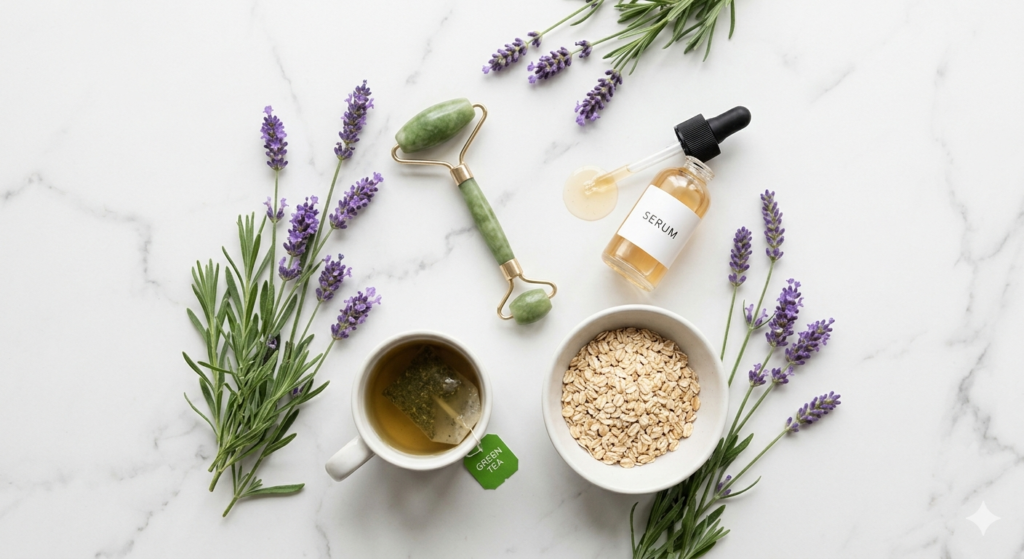
For best results, use a jade roller or gua sha tool with a light facial oil. Rosehip and jojoba both work very well. Spend just five minutes each evening working through tension in your face. Think of it, therefore, as pressing pause on your stress cycle.
5. Drink More Water
Similarly, dehydration makes everything worse. When you are low on water, cortisol rises even further. Collagen production also drops. As a result, your skin looks more lined and dull.
Therefore, drink at least 8 glasses of water per day. Herbal teas are a great addition too. For instance, chamomile and green tea both contain anti-inflammatory compounds that benefit your skin from within.
6. Never Skip Sunscreen
Finally, stressed skin is especially vulnerable to UV damage. After all, your barrier is weaker and inflammation is already higher. Consequently, skipping sunscreen at this time causes extra damage when your skin is least able to defend itself.
So use a mineral SPF of at least 30 every single morning — including cloudy days and work-from-home days.
When to See a Dermatologist
Sometimes, however, home care is simply not enough. In that case, see a dermatologist if you experience any of the following:
- Persistent cystic acne that does not improve
- A severe eczema or rosacea flare
- Unexplained hair loss
- Hives that keep coming back
A professional can, therefore, offer prescription treatments and confirm whether stress — or something else entirely — is the real cause.
A Note on Self-Compassion
Finally, and perhaps most importantly: your skin does not define you. Breakouts happen. Redness happens. Dull days happen. And they almost always happen when life is already hard enough.
So instead of adding skin stress to your mental load, try something different. Treat your skin the way you would treat a good friend having a rough time — gently, patiently, and without judgment.
Ultimately, consistency, calm, and kindness — in both your routine and your mindset — will restore your skin more than any miracle ingredient ever could. Your skin is listening to how you feel. Therefore, give it reasons to feel safe.
❓ FAQ: Quick Answers
Does stress really cause acne? Yes. Stress raises cortisol. As a result, cortisol increases oil production. Excess oil then clogs pores and triggers inflammation. Consequently, breakouts follow.
How long does it take for stress-related skin to recover? Generally, most skin issues begin to improve within 2–4 weeks of managing stress. However, fully repairing the skin barrier can take 4–6 weeks of consistent gentle care.
Can stress cause premature aging? Yes. Chronic high cortisol breaks down collagen and elastin over time. As a result, fine lines appear faster and skin loses its firmness sooner than it should.
What ingredients help stressed skin the most? Specifically, ceramides, niacinamide, hyaluronic acid, and squalane work best. Together, these repair the barrier, reduce redness, and restore hydration.
Does diet affect stress-related skin problems? Absolutely. Sugar and processed foods worsen inflammation. In contrast, anti-inflammatory foods like fatty fish, berries, and leafy greens actively help your skin recover.
Is sleep really that important for skin health? Yes, without a doubt. Skin repairs itself during sleep. Poor sleep raises cortisol, slows collagen production, and consequently worsens every stress-related skin condition.